






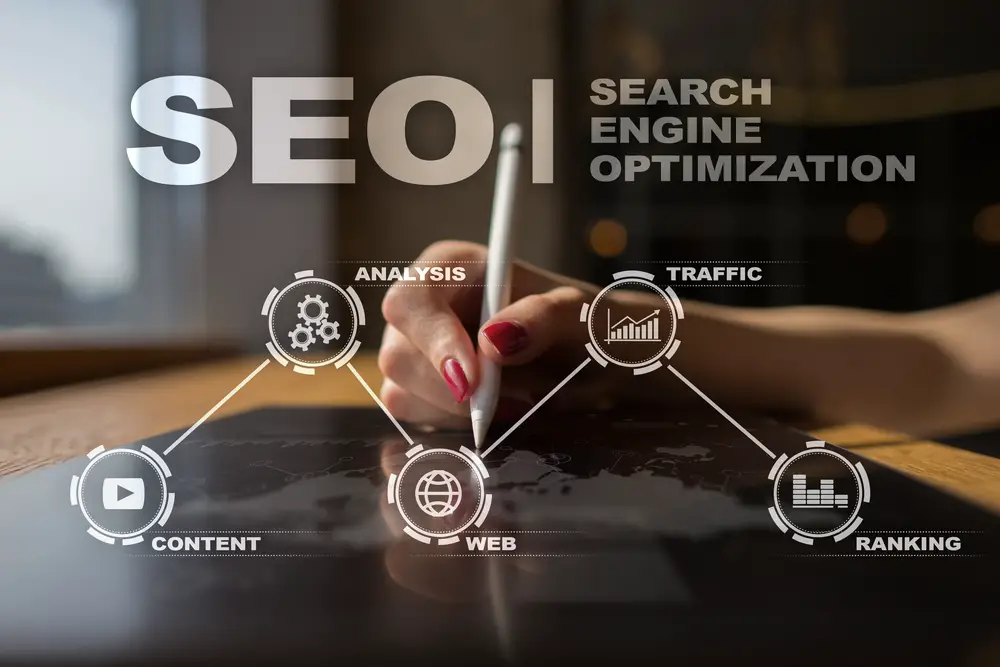

Ecommerce SEO services are a defined set of professional optimization activities — covering technical auditing, product and category content, link acquisition, conversion alignment, and performance measurement — applied specifically to online stores to generate sustainable organic traffic and measurable revenue growth from search engines in the Saudi market.
Ecommerce SEO Services vs. Standard SEO Services: The Fundamental Difference
Every Saudi business website benefits from SEO — but ecommerce stores require a fundamentally different service architecture than a corporate site, a law firm, or a healthcare practice. The confusion between standard SEO services and ecommerce SEO services is one of the most common and most expensive mistakes Saudi business owners make when purchasing search optimization.
A standard SEO program treats each URL as a content asset to be ranked. An ecommerce SEO program treats each URL as a commercial transaction point — a page that must not only rank but convert, not only attract visitors but qualify them, not only generate traffic but generate revenue. Every service delivered in an ecommerce SEO engagement is evaluated against a single question: does this improve the store’s organic revenue, not just its organic visibility?
This distinction cascades through every service component. Keyword research for an ecommerce store is not about finding topics to write about — it is about mapping the entire commercial search demand landscape for every product category the store sells, identifying which queries indicate purchase intent versus research intent, and building a prioritized service roadmap based on revenue potential per ranking achieved. Content development is not blogging — it is building the semantic authority architecture that allows category pages and product pages to rank for the queries that generate sales. Link acquisition is not citation building — it is earning the domain-level authority that lifts an entire product catalog’s ranking potential simultaneously.
| Ecommerce SEO services are specialized search engine optimization activities delivered specifically for online retail stores — encompassing technical site optimization, commercial keyword strategy, product and category page optimization, revenue-focused content development, link authority building, and conversion-aligned performance measurement — all calibrated to generate measurable organic revenue rather than organic traffic in isolation. |
The Service Delivery Gap: What Most Saudi Stores Are Actually Getting
The Saudi ecommerce market has a significant service delivery problem that most store owners do not identify until they have wasted 6 to 12 months of budget. The problem is the gap between what ecommerce SEO services are described as delivering and what they actually deliver in practice.
Most SEO engagements sold to Saudi ecommerce stores are structured around activity delivery — a defined number of keywords researched per month, a defined number of on-page optimizations completed, a defined number of backlinks built. The monthly report arrives, the checkboxes are populated, and the retainer is renewed. What is rarely tracked, reported, or tied to the service contract is the metric that actually matters: organic revenue from the store’s organic channel, broken down by product category, measured against the investment.
This activity-versus-outcome gap is why a significant proportion of Saudi ecommerce stores that have invested in SEO for six months or more report that they cannot identify a clear connection between their SEO investment and their business performance. The investment was real. The activities were real. The connection to revenue was never built into the service structure.
What Outcome-Oriented Ecommerce SEO Services Look Like
The alternative to activity-based SEO is outcome-oriented ecommerce SEO service delivery, where every component is defined by its expected commercial contribution. Technical audits are prioritized by the revenue impact of the issues they resolve, not by the number of issues found. Keyword research is organized by revenue potential per ranking achieved, not by search volume alone. Content is developed based on which commercial queries are currently unaddressed in the store’s category architecture. Links are acquired from sources that build category-specific authority rather than generic domain metrics. And reporting connects each service component to its measurable impact on organic revenue.

| The Service Accountability Standard
Before signing any ecommerce SEO services contract, ask this question: ‘At the end of 12 months, how will we measure whether this investment generated positive ROI?’ If the answer involves keyword rankings, domain authority scores, or traffic volume, negotiate for a reporting framework that includes organic revenue attribution, organic conversion rate by landing page type, and cost-per-organic-acquisition by product category. These are the metrics that tell you whether your ecommerce SEO services are working. |
Service 1: Ecommerce Technical SEO Audit and Remediation
The technical SEO audit is the diagnostic foundation of every ecommerce SEO services engagement — and its quality determines the ROI of everything that follows. A thorough ecommerce technical audit is categorically different from the generic site audits produced by automated tools, and understanding that difference helps store owners evaluate the depth of what they are being offered.
What a Genuine Ecommerce Technical Audit Covers
An ecommerce-specific technical audit evaluates the systems that are unique to online retail at scale: crawl budget allocation across a large product catalog, indexation of category pages versus product pages versus filtered pages, the canonical configuration strategy across product variations, the structured data implementation quality for Product, Offer, and AggregateRating schema types, the hreflang configuration for bilingual stores serving Arabic and English audiences, and the Core Web Vitals performance measured in field data conditions rather than laboratory simulations.
Each of these audit components has a direct revenue implication. Crawl budget misallocation means Google spends its crawling capacity on low-value pages — filtered results, sorting parameters, pagination duplicates — rather than on the category and product pages that rank for commercial queries. Canonical misconfiguration fragments ranking signals across multiple URLs that should consolidate on one. Schema implementation failures eliminate rich result eligibility — review stars, price snippets, availability indicators — that directly affect click-through rates on search result pages.
Remediation: The Service Most Audits Omit
The audit deliverable that most ecommerce stores receive is a document: a list of technical issues ranked by severity with recommendations for resolution. What most stores do not receive — and what most SEO service providers do not include — is implementation. The audit identifies that 847 product variation URLs are generating duplicate content without proper canonical treatment. Someone then needs to implement the canonical strategy across those 847 URLs. If the service contract does not include technical implementation, the audit’s value is academic.
When evaluating ecommerce SEO services, always clarify: does the technical audit include implementation of the identified fixes, and what is the timeline for resolution of critical issues? A provider that delivers an audit document and leaves implementation to your development team is providing a fraction of the service value that an audit-plus-implementation engagement provides.
| Technical Audit Component | Why It Matters for Revenue | Remediation Complexity |
| Crawl Budget Optimization | Ensures Google indexes category & product pages, not filtered duplicates | Medium — robots.txt, noindex, parameter handling |
| Canonical URL Strategy | Consolidates ranking signals to single authoritative product URLs | High — requires site-wide implementation across variations |
| Product Schema Validation | Enables price, review, and availability rich results in SERPs | Medium — JSON-LD implementation or plugin configuration |
| Hreflang Configuration | Prevents Arabic/English versions competing against each other | High — requires systematic implementation across all pages |
| Core Web Vitals (Field Data) | Direct ranking signal — affects mobile search visibility | High — server, image, JavaScript, and CSS optimization |
| Internal Link Architecture | Distributes ranking authority from domain to product/category pages | Medium — navigation, footer, and content link review |
Service 2: Product Keyword Intelligence and Search Demand Mapping
Keyword research for ecommerce is the most commercially consequential service in any ecommerce SEO engagement — and the most commonly delivered at inadequate depth. The difference between keyword research that generates revenue and keyword research that fills a spreadsheet is the degree to which it captures the full commercial search demand landscape for every product category the store competes in.
The Four-Layer Ecommerce Keyword Architecture
Layer 1: Category-Level Commercial Keywords
The broadest layer of commercial intent — searches like ‘men’s running shoes Saudi Arabia’ or ‘home office furniture Riyadh.’ These queries indicate category browsing behavior from buyers who have not yet narrowed their choice. Category pages are the correct ranking target for these terms, and capturing first-page visibility for category-level queries generates the highest-volume organic traffic in any ecommerce SEO program. The service component here is identifying all commercially viable category queries across the store’s product range, estimating organic traffic potential per ranking position, and prioritizing by revenue potential.
Layer 2: Product-Level Transactional Keywords
Mid-specificity searches that indicate a buyer who knows what they want but has not yet chosen a specific brand or model — ‘wireless noise-cancelling headphones under 500 SAR’ or ‘stainless steel water bottle 1 liter.’ Product pages and sub-category pages are the correct targets for these queries. The keyword research service at this layer involves systematic mapping of product-level search demand across the store’s SKU range, identifying which product attributes Saudi consumers include in their search queries, and structuring product page titles and content to match those patterns.
Layer 3: Brand and Comparison Keywords
High-intent searches that name specific brands, compare alternatives, or include strong purchase signals — ‘Samsung Galaxy S25 price Saudi Arabia,’ ‘Nike vs Adidas running shoes,’ ‘best protein powder for muscle gain KSA.’ These searches have the highest conversion rates of any organic traffic type and require dedicated landing pages or optimized product/category pages that match the specific intent precisely. Capturing this layer requires both product-level optimization and structured comparison content that answers the explicit competitive question in the search.
Layer 4: Arabic-Language Commercial Queries
The parallel Arabic keyword universe that exists independently of the English keyword landscape and requires separate research methodology. Arabic product searches in Saudi Arabia do not follow the same patterns as English product searches — the terminology reflects cultural conventions, regional preferences, and linguistic structures that direct translation cannot capture. Ecommerce SEO services that treat Arabic keyword research as translation of English keyword lists systematically miss the majority of Arabic search demand. Genuine Arabic keyword research uses Arabic-language search volume data, Arabic-language SERP analysis, and Arabic-language consumer behavior insight to build a demand map that reflects how Saudi consumers actually search.

Service 3: Product Page SEO — The Revenue-Generating Core
Product pages are the atomic revenue units of any ecommerce store — the pages where organic traffic converts into purchases. Every product page optimization service should be evaluated through the lens of its contribution to that conversion, not just to ranking achievement.
The Product Page Optimization Service Stack
A complete product page SEO service covers six distinct optimization layers. The first is title tag and meta description optimization — not just keyword inclusion, but intent-matched writing that addresses the specific search query a buyer used to arrive at the page, in language that converts. The second is on-page content development: original product descriptions that address Saudi consumer questions, specify local compatibility and availability, include intent-mapped keywords in natural language, and differentiate the product from the same SKU appearing on competitors’ pages.
The third layer is structured data implementation — Product schema with all commercially relevant fields populated: price in SAR with VAT-inclusive specification, availability status, aggregateRating from genuine verified reviews, brand entity, and product identifiers (GTIN, MPN) where available. Complete Product schema is the gateway to rich result formats — price snippets, review stars, availability labels — that directly affect click-through rates from search results pages.
The fourth layer is image optimization: descriptive ALT text in both Arabic and English, keyword-informed filenames, image schema connected to parent Product markup, and WebP formatting with lazy loading for Core Web Vitals compliance. The fifth is internal linking — connections from category pages and related products that consolidate ranking authority on the product page and distribute it across the catalog intelligently. The sixth is conversion optimization at the page level: trust signals, review prominence, payment method display, and product specification formatting that reduces friction between landing and purchase.
The Original Content Imperative
The single most impactful and most consistently ignored product page SEO service for Saudi stores is original content creation. The majority of Saudi ecommerce stores populate product pages with manufacturer-supplied descriptions — text that appears word-for-word on dozens of competing retailer pages simultaneously. Google’s duplicate content systems identify this pattern and systematically suppress stores that have not differentiated their product content.
Original product descriptions that address the specific questions Saudi consumers ask — ‘Is this certified by SASO?’ ‘Is the warranty valid in Saudi Arabia?’ ‘Does this ship from Riyadh for same-day delivery?’ — are not just SEO assets. They are conversion assets. A product description that resolves the specific concerns of a Saudi buyer removes the friction that sends them to a competitor’s page.
Service 4: Category Page Authority Development
Category page SEO is the highest-leverage service component in ecommerce search optimization — and the most systematically underinvested area in Saudi ecommerce stores. Understanding why requires understanding how commercial search intent distributes across the ecommerce funnel.
When a Saudi consumer types ‘running shoes’ into Google, they are at the top of a purchase journey. They have not yet chosen a brand, a price range, or a specific style. The page that captures this query is a category page — a page that organizes the store’s running shoe inventory and helps the buyer navigate toward a specific product. Google knows this, and its algorithm rewards category pages that genuinely help buyers make that navigation effectively. Category pages with expert product guidance, relevant filtering explanations, buyer criteria frameworks, and structured FAQ content consistently outrank category pages that serve as pure product grids, regardless of how many products appear in each.
The Category Content Service: What It Involves
Category page authority development as a service involves four components. First, keyword mapping: identifying the full set of commercial queries for which a given category page is the correct ranking target, organized by search volume and purchase intent. Second, content architecture: designing the category page content structure — introduction, buying guide section, FAQ, and featured product explanations — that satisfies both user intent and semantic completeness requirements.
Third, content creation: writing genuinely expert category introductions and buying guidance in both Arabic and English that help Saudi buyers make informed purchase decisions. This content must be written by specialists who understand the product category, not by content generalists applying SEO templates. Fourth, structured data: implementing ItemList schema that helps Google understand the organizational structure of the category and the relationships between category and product pages.
The Category Page ROI Argument
The financial case for category page SEO investment is straightforward. A first-page ranking for a high-volume category query — ‘women’s abayas online Saudi Arabia,’ ‘electronics online KSA,’ ‘baby products Riyadh’ — delivers significantly more organic traffic than any individual product page ranking can achieve. The category query has broader audience reach, captures buyers earlier in their purchase journey when brand preference is still forming, and generates organic traffic that distributes across multiple product pages through the buyer’s natural navigation. Investing in category page authority is investing in the highest-traffic layer of the ecommerce SEO funnel.
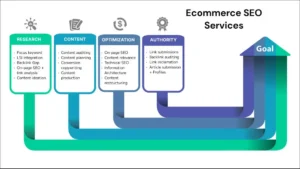
Service 5: Ecommerce Content Marketing and Topical Authority
Content marketing as an ecommerce SEO service operates differently from content marketing for informational sites or corporate brands. Every piece of content produced for an ecommerce store should serve a commercial purpose — not indirectly through brand building, but directly through capturing purchase-consideration queries and routing buyers toward the store’s product catalog.
Commercial Research Content
The highest-value content type for ecommerce SEO is commercial research content — articles that address the specific questions buyers ask when they are evaluating a purchase but have not yet committed to a product or retailer. ‘Best noise-cancelling headphones under 1000 SAR,’ ‘How to choose a treadmill for home use in Saudi Arabia,’ ‘WPC vs composite decking: which performs better in hot climates’ — these are queries where a buyer is making a decision, actively evaluating options, and ready to purchase once they have the information they need. Content that answers these questions authoritatively and links internally to the relevant product or category pages captures the buyer at their highest point of commercial readiness.
Seasonal and Event-Driven Content
Saudi ecommerce generates predictable seasonal search demand spikes that content marketing can capture months in advance. Ramadan gifting guides, National Day promotional content, back-to-school category roundups, Eid wishlist content, and Hajj season equipment guides all represent high-volume seasonal queries where stores with published, indexed, authoritative content ahead of the demand peak capture organic traffic that competitors without pre-built content cannot access. The ecommerce content service component here is a 12-month editorial calendar that anticipates seasonal demand and builds content far enough in advance to earn indexed ranking authority before the peak arrives.
Product Comparison and Buyer Decision Content
Comparison content — ‘Product A vs Product B,’ ‘The 5 Best [Category] Products in Saudi Arabia for 2026,’ ‘Is [Brand X] Worth It at This Price?’ — captures some of the highest-converting organic traffic available in ecommerce. These queries are asked by buyers who have done their initial research and are in the final stages of a purchase decision. Comparison content that is genuinely expert, covers the specific Saudi market context (local availability, warranty terms, price in SAR, SASO compliance), and links directly to the featured products on the store consistently converts at rates significantly above other content types.
Service 6: Ecommerce Link Acquisition — Quality Over Volume
Link acquisition for ecommerce stores serves two commercially distinct functions that most service descriptions conflate. The first is domain-level authority — backlinks that improve the entire store’s ranking potential across all product categories simultaneously by increasing the domain’s overall authority signals. The second is page-level authority — backlinks that point directly to specific category or product pages and provide targeted ranking power for the specific queries those pages are optimized for.
Domain Authority Links for Ecommerce
Domain authority links for Saudi ecommerce stores come from editorial coverage in Saudi consumer publications and regional lifestyle media, digital PR campaigns that generate coverage through original product research or market data, and brand-level mentions from influencers, journalists, and industry commentators that generate genuine editorial links rather than paid placement markers. These links improve the store’s ranking potential across all product categories simultaneously and are the most scalable link type available for large-catalog stores.
Category Authority Links
Category authority links target specific pages rather than the root domain and are most valuable for stores competing in specific high-value product categories where domain authority alone is insufficient to break through to first-page rankings. Supplier pages linking to authorized retailers, comparison sites featuring specific product categories, and industry publications covering specific product segments are the primary sources of category-level authority links for Saudi ecommerce stores.
What to Avoid: Link Schemes in the Saudi Market
Google’s Penguin algorithm updates have made manipulative link building — purchased links, private blog networks, link exchange schemes — increasingly risky and decreasingly effective. For Saudi ecommerce stores with significant organic revenue at stake, a single spam link penalty can represent weeks or months of lost organic sales during recovery. The only sustainable link acquisition service for ecommerce stores is one that earns editorial links through genuine value — product quality coverage, expert content citations, and brand authority that journalists and publishers reference voluntarily.
| Link Type & Source | Authority Benefit | Risk Level |
| Editorial Product Coverage — Saudi consumer media & lifestyle publications | Domain-wide authority signal | Low — earned through genuine merit |
| Digital PR Campaigns — Journalists covering original store research or data | Domain + specific topic authority | Low — requires genuine PR effort |
| Supplier / Brand Pages — Manufacturer authorized retailer pages | Category-specific page authority | Very Low — legitimate commercial relationship |
| Comparison / Review Sites — Product comparison platforms and review aggregators | Product and category page authority | Low — requires genuine product quality |
| Purchased Link Schemes — Link farms, PBNs, paid placements without disclosure | Short-term ranking, long-term penalty risk | Very High — AVOID entirely |
Service 7: Conversion Rate Optimization Integrated with SEO
The integration of conversion rate optimization with ecommerce SEO services is the most underutilized value multiplier in Saudi ecommerce marketing. Most stores treat SEO and CRO as separate workstreams — SEO drives traffic, CRO converts it — managed by different teams with different metrics and different reporting lines. This separation systematically leaves revenue on the table.
An ecommerce SEO services program that integrates CRO recognizes that the goal of every organic ranking achieved is not the ranking itself, but the purchase that follows from the visitor who arrives through that ranking. This integration changes the service focus: not just ranking product and category pages, but optimizing those same pages for the conversion behaviors of the organic visitors who arrive on them.
Trust Signal Implementation
Saudi ecommerce conversion is heavily dependent on trust signals — elements that reassure buyers that the store is legitimate, that products are genuine, that orders will arrive, and that returns are possible. For SEO-optimized pages, trust signals include verified review display with aggregateRating schema, accepted payment method logos (particularly mada and Apple Pay, which Saudi consumers associate with payment security), SASO certification badges for relevant product categories, and clear return and warranty policy information. Each of these signals affects both the page’s E-E-A-T signals — which influence rankings — and its conversion rate — which determines the revenue value of each ranking achieved.
Page-Level A/B Testing for Organic Landing Pages
Product and category pages that earn organic rankings represent a known, predictable traffic source — making them ideal candidates for A/B testing. When an ecommerce SEO services program identifies that a category page is ranking on Page 1 for a high-volume commercial query but converting at below-benchmark rates, the correct service response is not just continued SEO optimization but a structured A/B testing program on that page to identify what conversion barrier is preventing buyers from proceeding. The combination of SEO-generated traffic and CRO-generated conversion improvement on that traffic is the highest-leverage revenue action available for that page.
Service 8: Revenue Attribution and Performance Reporting
Revenue attribution reporting is the service component that makes every other ecommerce SEO service accountable — and the component that is most consistently absent from Saudi ecommerce SEO engagements. Without revenue attribution, an ecommerce SEO program cannot prove its ROI, cannot prioritize its service activities toward the highest-value opportunities, and cannot identify which service components are delivering commercial value versus which are delivering activity metrics.
The GA4 Ecommerce Tracking Foundation
Accurate revenue attribution for ecommerce SEO requires GA4 with full ecommerce tracking implemented and validated — not just pageview and session tracking. This means purchase events with revenue values, product impressions from category pages, add-to-cart events, checkout funnel steps, and the organic channel attribution that correctly assigns each conversion to its originating search query. The GA4 implementation audit and configuration is a standalone service component that should be completed before any performance claims are made or any optimization priorities are set.
The Reporting Framework That Makes SEO Accountable
A revenue-accountable ecommerce SEO reporting framework answers four questions every month. First: what did our organic channel generate in revenue this month, compared to last month and the same period last year? Second: which product categories generated the most organic revenue, and how have those category rankings changed? Third: which keywords delivered converting organic traffic, and what is the average organic conversion rate versus other traffic sources? Fourth: what specific service activities were completed this month, and what is the measurable change in the organic metrics that connect to those activities?
This reporting framework is not a dashboard update — it is a strategic accountability mechanism that connects every service dollar spent to a commercial outcome. Providers who deliver this level of reporting are operating as revenue partners. Providers who deliver keyword ranking reports and traffic graphs are operating as activity vendors.

Service 9: AI Search Optimization for Ecommerce (GEO + AEO)
The ecommerce search landscape in 2026 includes a meaningful and growing component that exists outside traditional Google blue-link results: AI-generated product recommendations, purchase guidance, and comparison answers delivered by Google AI Overviews, ChatGPT Shopping, Perplexity commerce features, and Gemini product queries. Saudi consumers are increasingly using AI search interfaces to research products and compare alternatives before purchasing — making AI search optimization a commercially relevant ecommerce SEO service for 2026 forward.
Generative Engine Optimization for Product Pages
GEO for ecommerce product pages involves structuring product information so that AI search systems can extract, synthesize, and cite it in response to product research queries. The content characteristics that AI systems favor for product pages include: structured specification tables with complete product attributes, clear price and availability information, authentic review summaries with specific user experiences, and definitive answers to the specific questions buyers commonly ask about the product. These characteristics are identical to those that improve traditional product page SEO — making GEO optimization for product pages a natural extension of existing ecommerce SEO services rather than a separate workstream.
AEO for Category-Level Commercial Queries
Answer Engine Optimization for ecommerce focuses on ensuring that category-level and comparison-level queries — ‘what are the best noise-cancelling headphones available in Saudi Arabia?’ — return the store’s category pages or comparison content as cited sources in AI-generated answers. The optimization requirements are: comprehensive content that addresses the buyer’s question completely, structured formatting that is easy for AI systems to parse, expert authorship signals that establish topical authority, and schema markup that clearly identifies the content’s subject matter and the store’s relationship to the products discussed. Saudi ecommerce stores that implement AEO-optimized category content are positioning themselves to be cited as authoritative sources in the AI-generated product guidance that is increasingly influencing Saudi purchase decisions.
| 2026 Ecommerce AI Search Insight
Early data from Saudi ecommerce stores with AEO-optimized category pages shows that AI-generated answer citations drive higher-quality traffic than traditional organic click-throughs — visitors who arrive via AI answer citations have higher average order values and lower bounce rates than visitors from standard organic results for the same queries. Optimizing for AI citation is not just a future consideration — it is a current commercial opportunity for Saudi stores willing to invest in the content quality standards that AI systems reward. |
How to Build an Ecommerce SEO Services Budget That Makes Financial Sense
The most common mistake Saudi store owners make when budgeting for ecommerce SEO services is evaluating the monthly retainer in isolation — comparing it against other marketing costs rather than against the revenue opportunity that organic search rankings represent in their specific product categories.
The Revenue Opportunity Framework
A financially rational ecommerce SEO budget starts with a revenue opportunity calculation, not a service price comparison. The calculation: identify the top 10 commercial category queries in your product range, estimate the monthly search volume for each, estimate the average conversion rate for organic traffic in your category, calculate the average order value, and multiply across the ranking scenarios. This produces an estimate of the organic revenue available to your store from first-page rankings in those categories — and that estimate is the ceiling value of your SEO investment.
For a Saudi electronics retailer with average order values of SAR 800 targeting category queries with combined monthly search volumes of 50,000, even a conservative 2% organic click-through rate at Position 3 and a 2% conversion rate produces SAR 16,000 per month in organic revenue. An ecommerce SEO services investment of SAR 10,000 per month that generates those rankings delivers a 60% monthly ROI — a return that most paid advertising channels in competitive Saudi electronics categories cannot approach at equivalent cost.
Ecommerce SEO Service Pricing Reality
Ecommerce SEO services in Saudi Arabia span a wide range, and the pricing reflects genuine capability differences rather than arbitrary margin variation. Entry-level engagements from SAR 4,000 to SAR 6,000 per month typically cover basic technical auditing, on-page optimization of priority pages, and minimal content production — appropriate for small single-category stores in low-competition niches. Growth-stage engagements from SAR 6,000 to SAR 15,000 per month include systematic technical remediation, bilingual content programs, structured link acquisition, and GA4 revenue reporting — appropriate for multi-category stores competing in mid-competition categories. Full-spectrum ecommerce SEO programs from SAR 20,000 to SAR 40,000+ per month deliver the complete service stack described in this article — appropriate for high-volume stores in competitive categories where organic revenue at stake justifies the investment.
The Ecommerce SEO Services Procurement Checklist
Use this checklist when evaluating any ecommerce SEO services proposal for a Saudi online store:
Service Scope Verification
✓ Does the proposal specify which technical issues will be implemented, not just audited?
✓ Is keyword research divided by Arabic and English with separate methodology for each language?
✓ Does on-page optimization include original content creation or only meta tag updates?
✓ Is category page content development explicitly included as a service component?
✓ Does the link acquisition service specify the types of sources targeted and the editorial standards applied?
✓ Is conversion rate optimization integrated with SEO service delivery or treated as a separate engagement?
✓ Does the proposal include GA4 ecommerce tracking audit and revenue attribution setup?
Performance Accountability Verification
✓ Does the reporting framework include organic revenue by product category, not just keyword rankings and traffic?
✓ Is there a defined measurement methodology for calculating organic conversion rate from the SEO channel?
✓ Does the contract specify the baseline metrics that will be established in Month 1 and tracked throughout?
✓ Is there a quarterly business review process that connects SEO service activities to commercial outcomes?
Provider Capability Verification
✓ Has the provider delivered ecommerce SEO services for Saudi stores in your product category?
✓ Can the provider demonstrate bilingual Arabic-English SEO capability with native Arabic content quality?
✓ Does the provider have platform-specific experience with your specific ecommerce platform?
✓ Is technical implementation included in the service or dependent on your development team?
Read About : SEO Ecommerce Agency
Frequently Asked Questions
What are ecommerce SEO services?
Ecommerce SEO services are a defined set of professional optimization activities applied specifically to online stores to improve organic search visibility and generate measurable revenue from search engines. They differ from standard SEO services in their commercial orientation — every service component is evaluated by its contribution to organic revenue, not just organic traffic. Core ecommerce SEO services include technical auditing and remediation, product and category keyword research, product page optimization, category page authority development, commercial content marketing, link acquisition, conversion rate optimization, revenue attribution reporting, and AI search optimization.
How are E-commerce SEO services different from regular SEO services?
Regular SEO services optimize websites for organic visibility and traffic. Ecommerce SEO services optimize online stores for organic revenue. The difference is in service architecture: ecommerce SEO requires product-level keyword strategy, catalog-scale technical optimization (handling thousands of product URLs, variations, and category pages), structured data for rich result eligibility, conversion alignment between ranking and purchasing, and revenue attribution reporting that connects search rankings to sales. A provider who delivers standard SEO services for corporate websites without ecommerce-specific capabilities will systematically underperform for online store clients.
How long does it take for ecommerce SEO services to generate revenue?
Ecommerce SEO services generate revenue on a timeline that depends on the store’s current technical baseline, existing organic authority, competitive intensity in the target categories, and the depth of services being implemented. Technical remediation — fixing critical issues that are actively suppressing rankings — often produces measurable organic traffic improvement within 30 to 60 days. Category page optimization typically generates ranking movement within 60 to 90 days. Systematic organic revenue growth, where the investment clearly produces positive ROI, generally becomes measurable within 6 to 12 months for competitive categories and 3 to 6 months for less competitive niches.
What ecommerce SEO services are most important for Saudi stores?
For most Saudi ecommerce stores, the highest-priority service components in order of immediate revenue impact are: technical audit and remediation (resolving issues that actively suppress existing organic potential), category page content development (capturing the highest-volume commercial queries), bilingual Arabic keyword research (accessing the Arabic-language organic demand that competitors have ignored), and revenue attribution reporting (establishing the measurement framework that makes all subsequent investment decisions financially rational). Product page optimization, link acquisition, and AI search optimization follow in priority depending on the store’s category competitiveness and existing organic authority.
Do ecommerce SEO services include content creation?
They should — and content creation is the service component most frequently absent from ecommerce SEO engagements sold in the Saudi market. Effective ecommerce SEO requires original product descriptions, category page buying guides, commercial research articles, and comparison content — all of which require genuine content creation, not just meta tag optimization. When evaluating an ecommerce SEO services proposal, confirm explicitly that original bilingual content creation is included and ask for examples of the Arabic content quality standard the provider delivers. The absence of genuine content creation capability is one of the most reliable indicators that a provider’s results will be limited to technical optimization without the topical authority development that drives competitive ranking.
How do ecommerce SEO services measure success?
Ecommerce SEO services should measure success through a revenue-oriented reporting framework: organic revenue by product category month-over-month, organic conversion rate from the organic channel versus other traffic sources, keyword-to-revenue mapping that identifies which search queries are generating purchases, and cost-per-organic-acquisition calculated against the monthly service investment. Providers who report success through keyword ranking positions, domain authority scores, or total organic traffic volume without connecting these metrics to commercial outcomes are measuring activity, not results.
What is the difference between ecommerce SEO services and paid search for Saudi stores?
Paid search (Google Ads, Google Shopping) generates immediate visibility that stops when the campaign budget is exhausted. Ecommerce SEO services generate organic authority that compounds over time and continues delivering organic traffic and revenue without incremental cost per click. The practical financial difference for Saudi stores: paid search has a predictable and typically rising cost-per-click in competitive product categories, while ecommerce SEO has a fixed monthly service investment that generates increasing organic revenue as authority compounds. Most Saudi stores benefit from running both — paid search for immediate revenue while SEO builds the organic authority that reduces long-term paid search dependency.
How do I know if my current ecommerce SEO services are working?
Your current ecommerce SEO services are working if you can answer yes to these questions: Is our organic revenue from search increasing month-over-month, adjusted for seasonal patterns? Are our category pages ranking on Page 1 for the commercial queries with the highest purchase intent in our product range? Is our organic conversion rate comparable to or better than our paid search conversion rate? Do our monthly reports connect specific service activities to specific changes in organic revenue? If you cannot answer yes to these questions, your current ecommerce SEO services are delivering activity rather than outcomes.
Conclusion
Ecommerce SEO services in Saudi Arabia are not a commodity purchase — they are a structured investment in organic revenue generation that compounds in commercial value over time. The Saudi stores that dominate organic search results in their product categories are those that have invested in the full service stack described in this article: technical foundations that allow Google to index and rank their catalog correctly, bilingual keyword strategies that capture both Arabic and English commercial search demand, product and category content that earns genuine ranking authority through semantic depth, link acquisition that builds the domain-level authority needed to compete in high-volume categories, and revenue attribution reporting that makes every service component commercially accountable.
The gap between ecommerce SEO services that generate measurable revenue and those that generate impressive-looking reports is almost entirely a gap in service depth and commercial accountability. The stores that close that gap — that demand revenue-oriented services rather than activity-oriented services — are the stores that build the organic revenue streams that reduce their long-term dependence on paid advertising and create sustainable competitive advantages in their product categories.
Every month without a comprehensive ecommerce SEO services program is a month of compounding organic authority transferred to competitors who are investing. The question is not whether ecommerce SEO services generate ROI in the Saudi market — they do, demonstrably, for stores in virtually every product category. The question is which stores capture that ROI and which ones continue funding their competitors’ organic growth.
| Start Growing Your Store Through Organic Search
DG Solutions delivers end-to-end ecommerce SEO services for Saudi online stores — from technical audits to bilingual content programs to revenue attribution reporting. Every service we deliver is designed to generate measurable organic revenue, not impressive-looking metrics. ▸ Request Your Free Ecommerce SEO Audit ◂ dgsolutions.sa · info@dgsolutions.sa · Riyadh, Saudi Arabia |